
Pit lane / Guide
Hobby grade brushless RC cars for adults, starting with the motor
Why a brushless can changes everything about a radio control car, and what else has to change with it.
What hobby grade actually means
The line between toy grade and hobby grade has nothing to do with price and everything to do with parts. A hobby grade vehicle is one where the motor, the speed control, the servo, the shocks, the gears and the tires are all separate items you can buy and fit. A toy is a sealed object that becomes rubbish when one part fails.
That is the whole argument for hobby grade brushless RC cars for adults. A three year old car with a replaced motor, fresh shocks and a second set of wheels is a better vehicle than it was new, and the shelf of accessories behind it is what makes that possible.
Brushed motors: how they work and where they still make sense
A brushed can uses carbon brushes pressed against a commutator to switch current through the windings as the rotor turns. It is simple, cheap, and it will run from a two cell LiPo battery with nothing more than a basic speed control.
The brushes wear. Power fades, the motor runs hotter, and eventually it stops. That is a known cost rather than a defect, and for a learner's monster truck it is the right trade: gentle power delivery, forgiving throttle, and a replacement can that costs very little.
Brushless motors: the switching moves outside
A brushless motor has no brushes and no commutator. The switching happens in the speed control, which energises three sets of windings in sequence and reads the rotor position as it goes. Nothing rubs, so nothing wears out, and the efficiency that used to be lost as friction and sparking becomes torque instead.
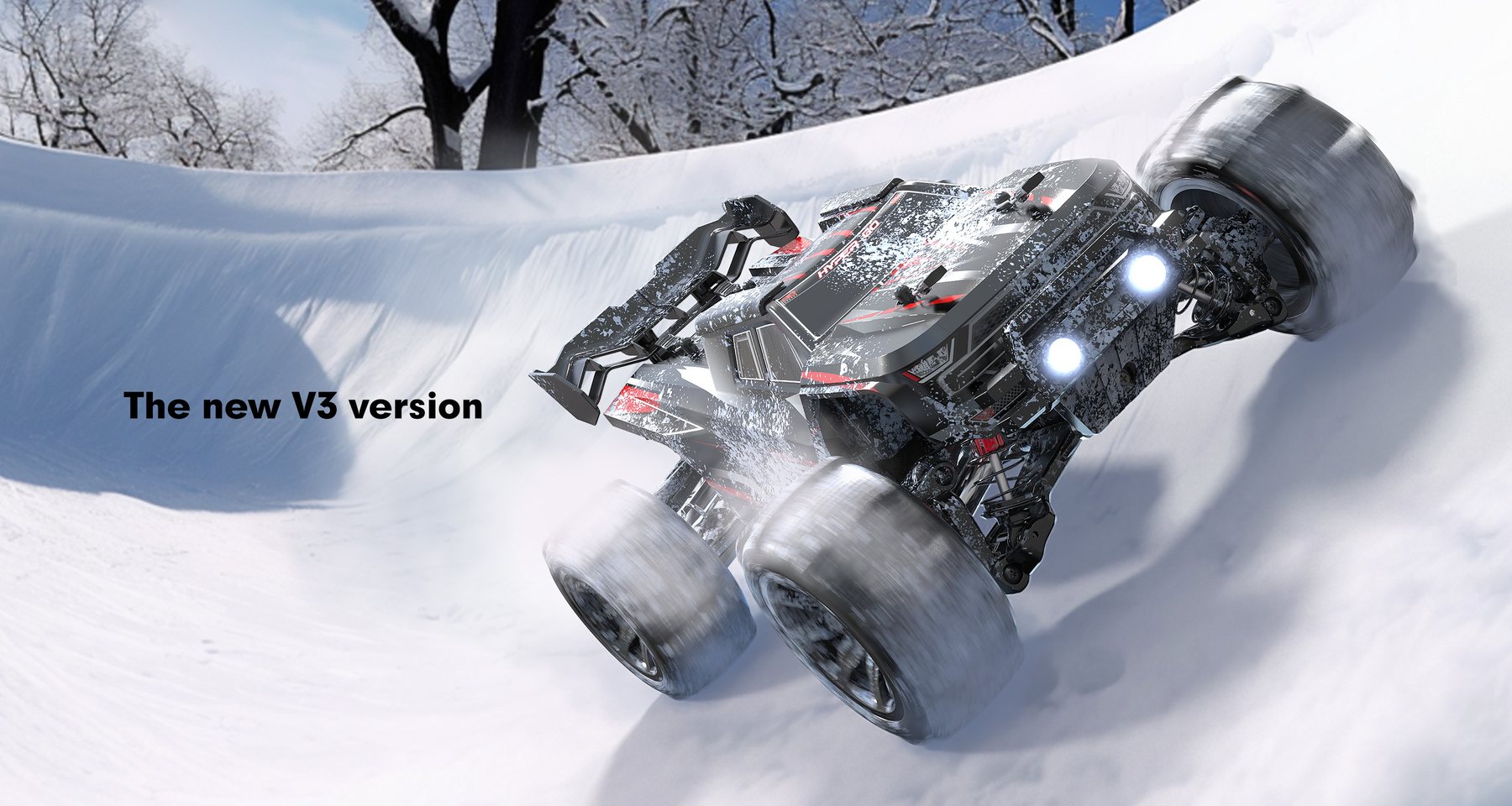
The practical result is more power from the same size can, far less heat, and a motor that outlasts the car around it. A 2845 brushless on a three cell pack will push a 1/16 scale truck past forty miles an hour.
The speed control has to match
This is the part people get wrong. A brushed speed control cannot drive a brushless motor, and a brushless unit will not run a brushed can. They are different devices that happen to sit in the same place in the loom.
A modern brushless unit also does more than meter power. It detects whether a 2S or 3S LiPo battery is plugged in, sets its low voltage cutoff to protect the cells, and limits current to keep itself alive. On our cars that is the E45M, E45P or E45K2 at 45 amps with a heatsink.
What else has to be strong enough
Fitting a powerful motor to a weak chassis just moves the failure. Hobby grade brushless RC cars for adults need metal gears, a sealed differential, metal CVD drive shafts and oil filled shocks, because the extra torque arrives at the drivetrain as spikes and the extra speed arrives at the suspension as landings.
4WD matters here too. Putting that much power through two wheels on loose dirt produces smoke and very little progress. Four wheel drive is what turns the figures on the box into something you can actually use.
Batteries, chargers and run time
Brushless efficiency means more of the pack reaches the ground, but a faster car covers more ground per minute, so run time does not improve as much as the numbers suggest. Plan on eight to twelve minutes per pack and own at least two.
Charge with the cable made for the cell count. Keep packs at half charge in storage, let them cool before charging, and retire any that swell. The battery is the one item in the hobby with a failure mode worth respecting.
Choosing a first ready to run car
Ready to run means the vehicle arrives built, painted, bound to its transmitter and carrying a charger. For an adult starting out, that is the right format — kit building is a separate hobby and a poor way to learn how a car should feel when it is working.
Pick the scale for your ground rather than the speed for your pride. A 1/16 truck suits a car park and a park path. A 1/14 monster truck carries more wheel through grass. Both want a 2S pack for the first month.
Looking after it
Blow the heatsinks and the motor fans out after dusty runs, check the wheel nuts after the first session on new tires, and keep a screw kit and a spare lower arm set in the box. Those three habits remove most of the downtime people complain about.
When something does break, the model code on the chassis is the key to every spare on our site. Write it on the lid of the box; the sticker will not survive the second season.
The shapes hobby grade brushless RC cars come in
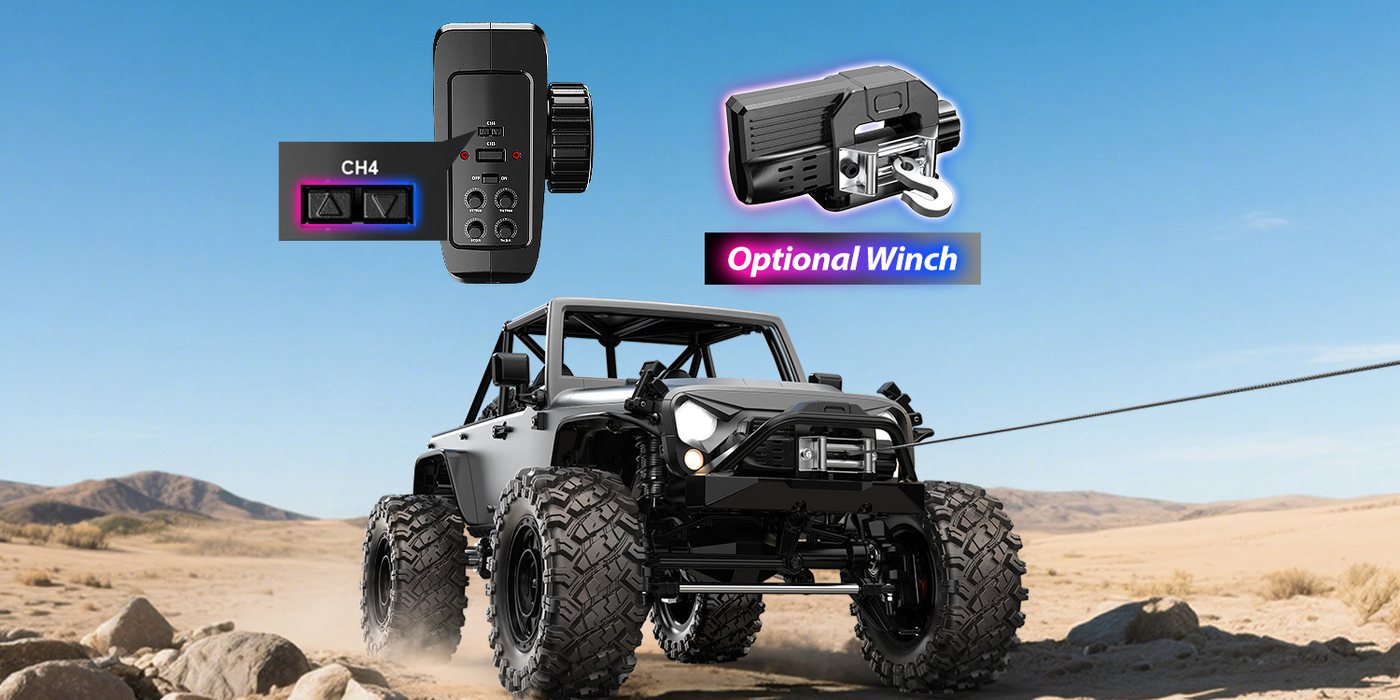
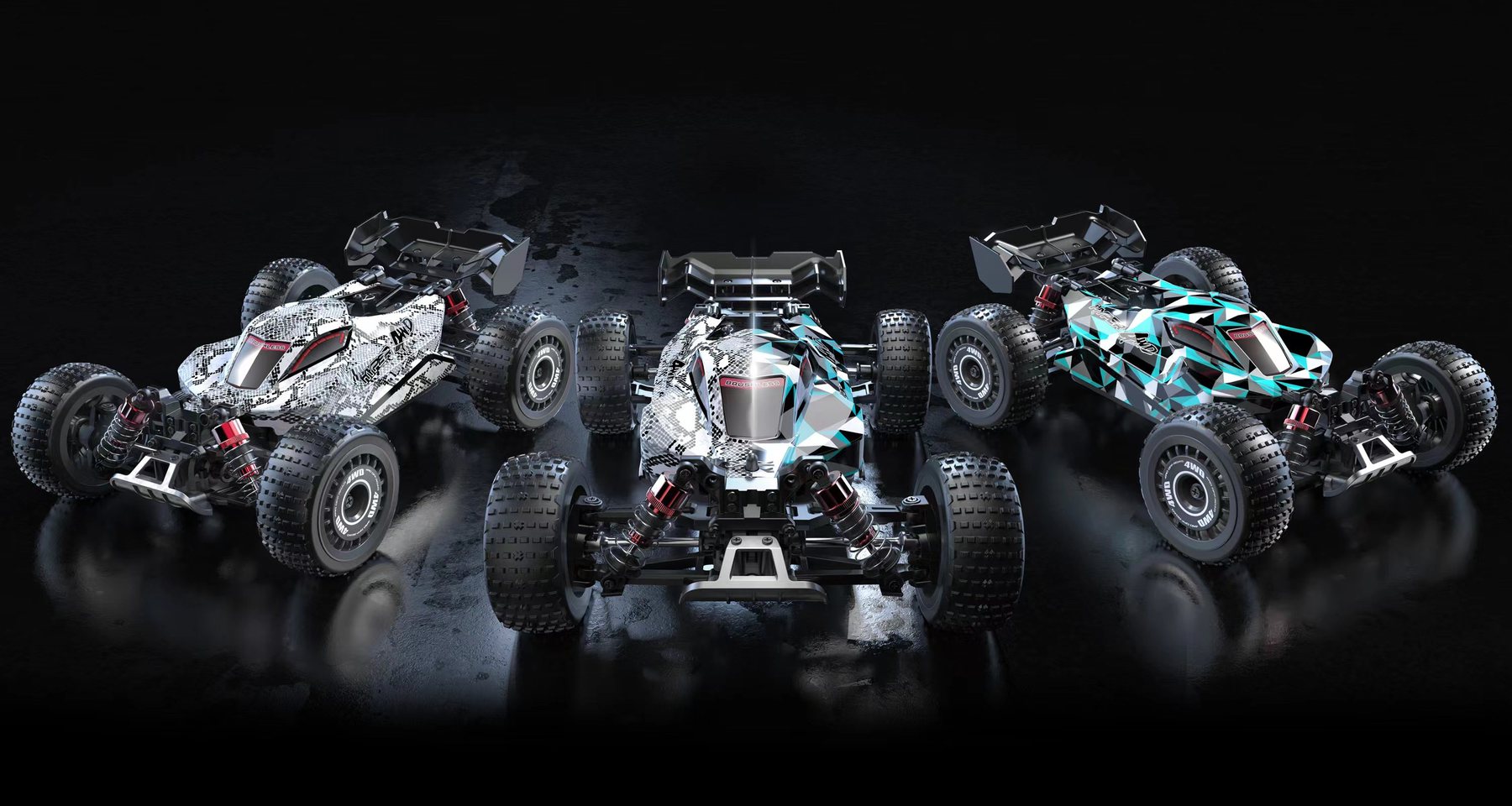
Most of what adults buy falls into four shapes. Monster trucks sit high on big tires and are the default for rough ground and bashing. Short course trucks have enclosed bodies and are steadier at speed. Buggies are lower and faster on a smooth track. Rock crawlers give up speed entirely for articulation and torque, and are a different hobby wearing the same radio.
RC monster truck sales dominate because they cope with the most ground. Our own range is built around exactly that: a 1/16 RC truck at 42 mph, a 1/14 at 50 mph, and a brushed monster truck for anyone whose first remote control car this is.
Reading the specification on remote control cars and trucks
Scale tells you size: 1/16 is roughly a shoebox, 1/10 is a car seat. 4WD and 2WD describe how many wheels receive power — four is more capable on dirt, two is cheaper and more playful on tarmac. RTR, or ready-to-run, means the vehicle arrives built, bound and painted with a charger in the tray.
Mph figures are measured on a 3S LiPo battery on a smooth surface, and they are real but optimistic for grass. Treat them as a ranking between models rather than as a promise about your local car park.
What a realistic first year looks like
Expect to replace tires, a pair of shocks, a lower arm and a handful of screws. Expect the battery charger that came in the box to be adequate and the single pack to be frustrating. Expect the first serious crash within a fortnight and the car to survive it.
That is the ordinary experience of hobby grade brushless RC cars for adults, and it is why the accessories shelf matters as much as the vehicle. A mini crawler, a desert runner and a dirt track basher all wear the same consumables.
Fully understanding the power system
Battery, speed control and motor are one system and have to be matched. A 3S brushless setup on a car designed around 2S will reach higher speeds and will find the weakest metal part in the drivetrain within a month. A modular chassis with a sealed differential and metal shafts handles it; a toy does not.
This is where hobby grade pays for itself. Every element — motor, electronics, gears, bodies, wheels — is a part number you can buy, so the car is built to be rebuilt rather than replaced.
Side by side
| 390 brushed (1639C) | 2845 brushless (B284B) | |
|---|---|---|
| Switching | carbon brushes | electronic, via ESC |
| Wear parts | brushes and commutator | bearings only |
| Heat under load | rises quickly | stays lower, fan cooled |
| Speed control | RE353 35A 2-in-1 | E45M / E45P / E45K2 45A |
| Fitted to | H16DR, H16SC, H16GT | H16BM, 16208, 16209, 16210 |
Questions we get asked
- Are brushless motors worth it for a beginner?
- If the car is ready to run and you start on a 2S pack, yes. You get the durability and the efficiency immediately and you can add the speed later with nothing more than a different battery.
- How long does a brushed motor last?
- A season of regular running, usually. The brushes and the commutator wear together, and a can that has lost noticeable power has reached the end of a normal life rather than failed.
- Can I convert a brushed car to brushless?
- It needs a new motor, a new speed control, usually a new pinion and often stronger gears. On a small chassis it costs more than buying the brushless version of the same car.
- What makes a car hobby grade rather than a toy?
- Spare parts. If the motor, shocks, gears and tires are separately available and designed to be replaced with hand tools, it is hobby grade.
- Is a monster truck the right first RC car?
- For most adults, yes. It handles grass, gravel and dirt without a track, the ground clearance forgives mistakes, and the tires are cheap.
- How fast is fast enough?
- Thirty miles an hour is already quick in a car park. Forty and above wants real space, and anything faster is a track car whether or not it is sold as one.